
cre·du·li·ty noun
a tendency to be too ready to believe that something is real or true
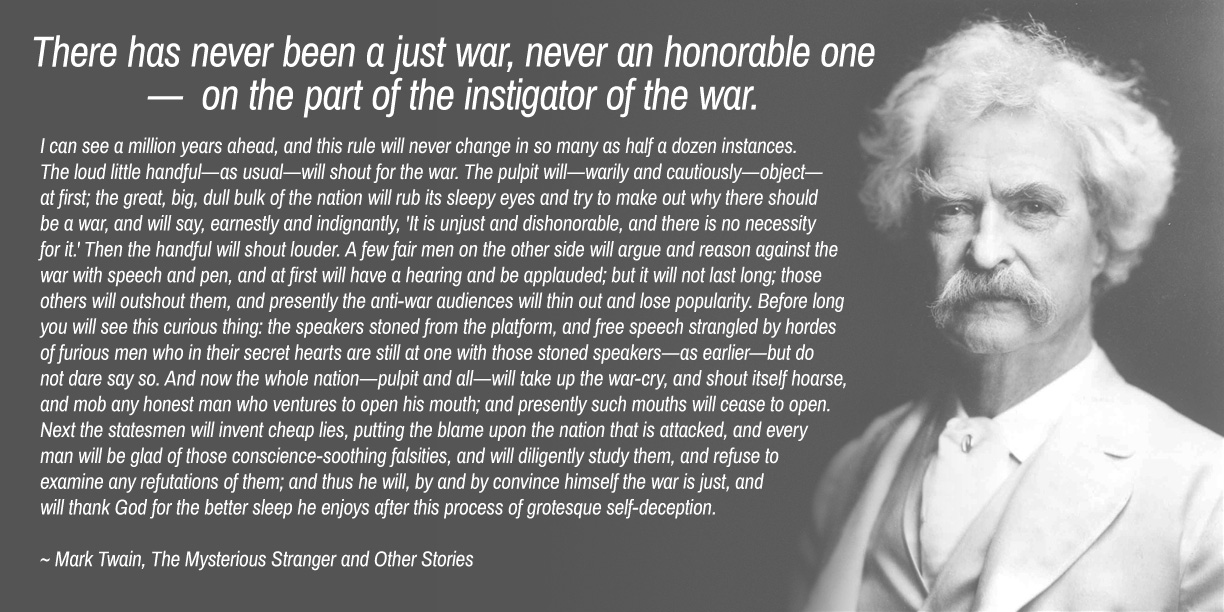
"There has never been a just [war], never an honorable one — on the part of the instigator of the war. I can see a million years ahead, and this rule will never change in so many as half a dozen instances. The loud little handful — as usual — will shout for the war. The pulpit will — warily and cautiously— object — at first; the great, big, dull bulk of the nation will rub its sleepy eyes and try to make out why there should be a war, and will say, earnestly and indignantly, 'It is unjust and dishonorable, and there is no necessity for it.'...and some input on the subject by a less enlightened character, Hermann Göring, from an interview given from his jail cell during the Nuremberg trials (April 18, 1946):
Then the handful will shout louder. A few fair men on the other side will argue and reason against the war with speech and pen, and at first will have a hearing and be applauded; but it will not last long; those others will outshout them, and presently the anti-war audiences will thin out and lose popularity. Before long you will see this curious thing: the speakers stoned from the platform, and free speech strangled by hordes of furious men who in their secret hearts are still at one with those stoned speakers — as earlier — but do not dare say so.
And now the whole nation — pulpit and all — will take up the war-cry, and shout itself hoarse, and mob any honest man who ventures to open his mouth; and presently such mouths will cease to open. Next the statesmen will invent cheap lies, putting the blame upon the nation that is attacked, and every man will be glad of those conscience-soothing falsities, and will diligently study them, and refuse to examine any refutations of them; and thus he will by and by convince himself the war is just, and will thank God for the better sleep he enjoys after this process of grotesque self-deception."
~ Mark Twain, The Mysterious Stranger and Other Stories
Göring: Why, of course, the people don't want war. Why would some poor slob on a farm want to risk his life in a war when the best that he can get out of it is to come back to his farm in one piece? Naturally, the common people don't want war; neither in Russia nor in England nor in America, nor for that matter in Germany. That is understood. But, after all, it is the leaders of the country who determine the policy and it is always a simple matter to drag the people along, whether it is a democracy or a fascist dictatorship or a Parliament or a Communist dictatorship.
Gilbert: There is one difference. In a democracy, the people have some say in the matter through their elected representatives, and in the United States only Congress can declare wars.
Göring: Oh, that is all well and good, but, voice or no voice, the people can always be brought to the bidding of the leaders. That is easy. All you have to do is tell them they are being attacked and denounce the pacifists for lack of patriotism and exposing the country to danger. It works the same way in any country.

"I had to stop hoping so much that a ship would rescue me. I should not count on outside help. Survival had to start with me. In my experience, a castaway’s worst mistake is to hope too much and do too little. Survival starts by paying attention to what is close at hand and immediate. To look out with idle hope is tantamount to dreaming one’s life away."
~ Yann Martel, Life of Pi


"Hate begets hate; violence begets violence; toughness begets a greater toughness.
We must meet the forces of hate with the power of love." ~ Martin Luther King, Jr.

